Why Your White Living Room Feels Cold (And How to Fix It With Cushions)
You painted the walls white for that clean airy look. Now the room feels like an office. You do not need to repaint or buy new furniture. The fastest way to shift the temperature of a white room is to change the colour palette of the cushions on it.
White rooms are a beautiful intention that often produces a colder result than expected. The walls stay white, the sofa stays neutral, and the room ends up feeling clinical instead of considered. This is not an architecture problem. It is a colour temperature problem, and cushions are the most direct tool available to solve it.
The Science of Colour Temperature
White reflects all light, which is exactly why it feels cool in rooms that do not get sustained warm natural light. The issue is not the white itself but the absence of anything that absorbs or warms the light coming into the space.
Warm tones like terracotta, mustard, amber, and deep gold absorb light rather than reflecting it, which shifts the entire visual temperature of the space around them. You are not adding colour to the white room so much as grounding it. The white stays. The room stops feeling empty.
This is why a single rust velvet cushion changes how a white room reads far more than you would expect from one object. It is not the cushion you are responding to. It is the warmth the cushion introduces into a space that was previously all reflected light.
The Warmth Cushion Formula
A white room needs a specific three-step cushion approach to feel warm rather than cold. Each step builds on the previous one, and removing any of the three reverts the arrangement back toward clinical.
STEP 1 The Neutral Anchor

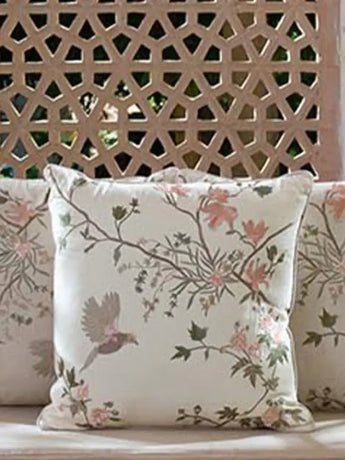
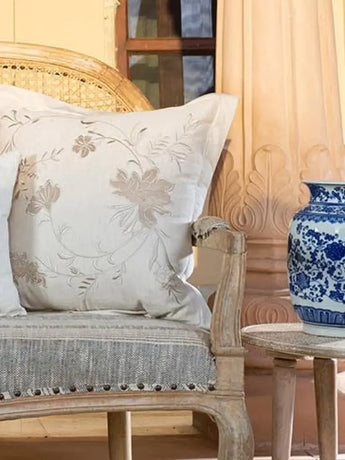
Start with one or two cushions in cream or ivory. These do not add warmth directly but they connect the sofa to the white walls around it, making the warmer tones you add next read as part of a considered palette rather than objects placed on a neutral surface.
MiRooh: Shazi Chikankari ivory cushions, Ekaani Oatmeal
STEP 2 The Warm Saturated Tone

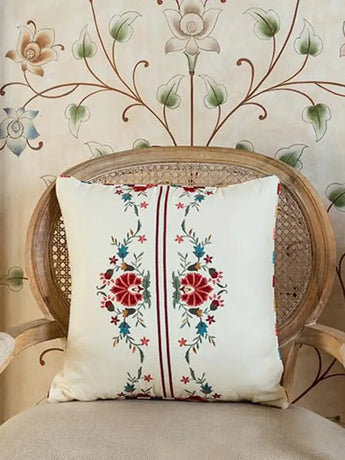
Add one or two cushions in a warm, saturated colour such as amber, rust, or terracotta. This is the step that actually changes the visual temperature of the room. The warm tone absorbs light and the entire white room softens around it. One piece is enough to feel the difference. Two pieces make it stable.
MiRooh: Daneen Red, Sitara Forest Green, Sultan Ruby
STEP 3 The Metallic Detail

Add one cushion with gold threadwork or metallic embroidery. Gold is the single most effective tool for making a white room feel warm and expensive because it mimics the quality of natural sunset light at its best angle. It does not need to be a large piece. A single embroidered statement piece carries the entire third step.
MiRooh: Mushfiq collection, Nazish Gold, Qadir Gold
Shop: Shop Mushfiq Collection | Shop Gulfam Collection | Browse All Cushions
Texture as a Tool for Warmth
Flat fabrics fail in white rooms not because of their colour but because of their surface. Flat printed fabric reflects light uniformly, which adds to the cool clinical quality of a white room rather than breaking it up.
Velvet is the most effective single fabric addition to a white room because its pile depth creates subtle shadows and highlights as light moves across it. No single colour change does as much for a white room as replacing one flat printed cushion with one velvet piece in the same colour.
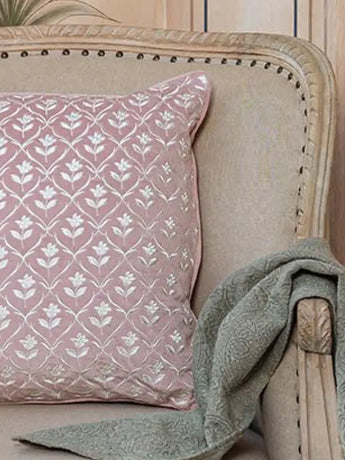
Layering adds to this. A throw draped over one armrest breaks the monotony of a flat sofa surface and introduces a different texture alongside the cushions. MiRooh's Ferdaus Bahaar Beige throw works particularly well in white rooms because the warm beige tone sits between the ivory anchor and the warmer cushion colours without pulling attention away from either.
Shop: Shop Ferdaus Bahaar Throw | Shop All Throws
What to Avoid
Cool-toned greys and blues in a white room amplify the coldness rather than balancing it. Both colours share the cool light temperature of white and together they reinforce the clinical feeling you are trying to escape. If grey is already present in the furniture or flooring, bring warm tones into the cushions specifically to counterbalance it.
Do not introduce more than three tones across the cushion arrangement. White rooms are unforgiving of visual clutter because there is nothing else in the room to absorb the noise. Three tones - your neutral anchor, your warm saturated colour, and your metallic detail - is both sufficient and correct. A fourth tone tips the palette into something the white walls will expose immediately.
Avoid matching the cushion colour exactly to the throw. When the cushion and throw are the same colour, neither element reads as distinct and the arrangement collapses into a single texture block rather than a layered one.
Three tones maximum. Cream or ivory as the anchor. One warm saturated colour. One gold metallic detail. Velvet on at least two of the three pieces. That is everything a white room needs from its cushions.
FAQ
Can I use patterns in a white room?
Yes. Choose tonal embroidery over high-contrast digital prints to keep the look cohesive. Chikankari white-on-white embroidery and Zari gold threadwork on velvet both add pattern and texture without introducing a competing visual element that fights the white walls.
How many cushions do I need for a three-seater sofa in a white room?
Four to five cushions in total keeps the arrangement looking airy and well-styled without cluttering a white space. One neutral anchor, two warm saturated pieces, one gold metallic statement, and one bolster at the front is the complete version of the warmth formula.
Why do my cushions look flat on my white sofa?
Flat surfaces and printed fabrics reflect light uniformly, which reads as dull against white walls. Switching to velvet or textured embroidery introduces pile depth and surface variation that creates visible shadows and highlights, which is what makes a cushion arrangement read as rich rather than flat.
Are gold accents too much for a white room?
Gold is one of the safest choices in a white room because it warms without competing. It mimics the quality of natural afternoon light and makes white walls look warmer rather than cooler. One gold embroidered piece in the arrangement is enough to shift the entire visual temperature of the room.
Your White Room Is Waiting for Its Warmth
Cream anchor. Amber or rust warmth. Gold metallic detail. Three tones and the right velvet. That is everything your white room needs.
SHOP MUSHFIQ COLLECTION SHOP ALL CUSHIONS
Guide: How to Layer Cushions Like an Interior Designer Browse Throws