Modern Navratri Home Decor for Indian Apartments
Apartment living usually rules out the kind of Navratri decorating that works in an independent house: no torans across a large entrance, no floor space for a full mandap, often no permission to drill into a rental wall. That doesn't mean an apartment has to look plain through the festival, and it doesn't mean going fully traditional is the only alternative. A modern apartment can look genuinely festive with a controlled palette, one strong focal point and a handful of well-chosen textiles, without new furniture, without clutter, and without the space starting to look like a shop display.
What Makes Navratri Decor Work in a Modern Indian Apartment?
Modern interiors tend to run on clean lines, a limited colour palette and open surfaces, which is exactly what festive decor tends to work against if you're not careful. The fix isn't to abandon the modern base, it's to work within it. Pick one or two focal points rather than decorating every surface, let a single strong colour carry the festive mood instead of introducing five, and use texture, velvet against a plain sofa fabric, for instance, to signal "festive" without needing extra colour at all. Scale matters too: in a smaller room, one large piece of wall art does more than several small ones, and a cushion arrangement that's slightly restrained looks more considered than one that fills every inch of the sofa.
1. Start With the Sofa: Style Cushions for Navratri
In most Indian apartments, a two or three-seater sofa is the main seating and the room's visual centre. For a two-seater, three cushions is usually enough; a three-seater can hold four to five without looking crowded. The modern version of this isn't a full sofa's worth of matching prints, it's two or three cushions that share a colour family but differ in pattern, and one plain or lightly textured cushion to give the eye somewhere to rest.
A useful way to think about it: pick one cushion as the statement piece with visible embroidery or a strong motif, one supporting cushion in a related but calmer tone, and if you're using a fourth, keep it close to your existing sofa colour so it blends rather than competes.

Vasuki Ruby Cushion
₹1,999
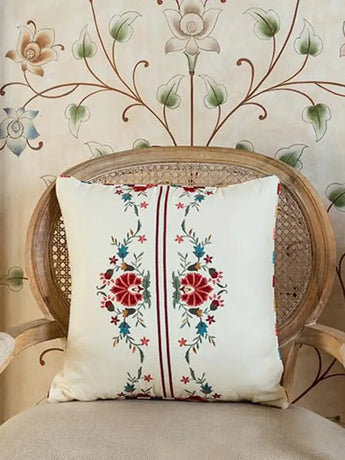
Ruby feather-touch velvet with a silk-thread embroidered motif and a zari border. Works as the one statement cushion in an otherwise neutral arrangement, so it doesn't need a second bold piece competing with it.
View the design
Mushk Copper Cushion
₹1,899
Copper velvet with a gold zari embroidered motif. The metallic tone reads as festive without introducing a second saturated colour, useful when you want to add just one accent to a neutral sofa.
View the design
Chitradha Cushion
₹1,999
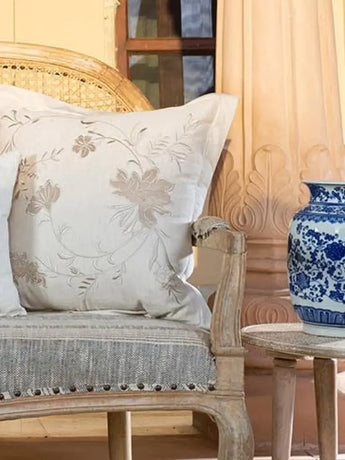
A softly faded floral print designed as a quiet anchor rather than a statement piece. Pairs well with a bolder cushion like Vasuki Ruby or Mushk Copper without competing for attention.
View the design
2. Use Wall Art to Create One Strong Festive Focal Point
Wall art works particularly well in apartments because it adds visual weight without taking up floor space, which matters in a smaller living room. Hang the piece above the sofa or on the wall directly opposite the main seating, sized to roughly two-thirds the width of the furniture below it. The centre of the frame should sit at standing eye level, generally 60 to 65 inches from the floor. One large, detailed piece will always look more intentional in a modern room than three or four smaller frames, which tend to read as clutter rather than curation.
Traditional Indian art, whether a Kalamkari panel or a hand-knotted textile piece, sits comfortably in a contemporary room because the surrounding furniture and walls stay simple. The artwork becomes the one place in the room where detail and colour are allowed to be rich, which is precisely what makes it work as a focal point.

Krishna Leela Black and White Wall Art
₹123,900
A 35 x 48 inch hand-painted and hand-embroidered Kalamkari panel in black and white. Because it carries no colour, it works as a focal point in almost any modern colour scheme, including a fully neutral one.
View the design
Antique Hand Knotted Teal Wall Rug
₹1,00,300
A 33 x 47 inch hand-knotted wool piece in teal with an antelope motif, inspired by antique Laos Tai silk weaving. A good option if the room's accent colour is closer to teal or blue-green than red or gold.
Discover Indian wall artExplore the wall art collection
3. Choose a Navratri Colour Palette Without Redecorating the Whole Room
A palette that works in a modern apartment usually has three parts: a base neutral the room already has, one festive accent colour, and a metallic touch that ties the two together. You don't need to commit to a colour for the whole nine days either; the base stays fixed and only the accent cushion needs to change if you want to follow the day's colour.
| Base neutral (existing) | Festive accent | Metallic tie-in |
|---|---|---|
| Ivory or white sofa | Ruby or copper | Gold zari |
| Beige or greige walls | Forest green | Gold or brass |
| Grey or charcoal sofa | Teal or sapphire | Silver or pale gold |
None of these combinations are culturally required; they're simply pairings that work with what MiRooh currently has in stock, chosen so the accent colour has somewhere to sit against without a full repaint. For the day-by-day breakdown of the nine Navratri colours, MiRooh's Guide to the 9 colours of Navratri 2026 covers that separately.
4. Modern Navratri Decor for Small Apartments
In a compact living room, every decision needs to earn its space. Some practical rules that hold up in smaller apartments:
- Keep the centre of the room and the main walkway clear of floor decor
- Use vertical wall space rather than horizontal spread, since a tall narrow piece takes up less visual width
- Choose one wall art focal point instead of a gallery wall
- Let the sofa carry most of the festive colour through cushions, rather than adding separate decor pieces around the room
- Keep coffee-table styling to one or two items, such as a small diya tray, rather than a full arrangement
The goal is a room that looks deliberately styled rather than filled. A small apartment with one wall art piece and three well-chosen cushions will generally look more festive than a larger room with decor scattered across every surface.
5. How to Mix Indian Decor With Modern Furniture
The combinations that consistently work well:
- Modern sofa + embroidered Indian cushion. A plain linen or cotton sofa gives an embroidered velvet cushion room to stand out instead of competing with another pattern.
- Contemporary wall + traditional Indian artwork. A bare, unpatterned wall is what makes a detailed wall art piece read as a statement rather than clutter.
- Neutral apartment + one rich festive accent. A single saturated colour, introduced through cushions, does more than several muted ones spread around the room.
- Minimal furniture + one statement wall-art piece. The fewer decorative objects a room has, the more visual weight the one remaining piece can carry.
6. Navratri Decor Ideas for Rental Apartments
If drilling isn't an option, most of the festive impact in this article still works without it. Cushions and throws need no wall fixings at all. For wall art, look for pieces that come with, or can be paired with, a stand or ledge shelf so they can lean against the wall rather than hang from it, or use removable, weight-appropriate hanging strips rated for the artwork's actual weight, following the product manufacturer's stated limits. Heavier or hand-knotted pieces, such as a wall rug, are generally better suited to a proper wall fixing rather than a leaning setup, so check a piece's weight before deciding how to display it. When in doubt, or if you're unsure a wall fixing will hold safely in a rented space, it's worth asking your landlord or a professional installer rather than guessing.
7. Create a Festive Living Room Without Making It Look Cluttered
A simple way to keep a room from tipping into clutter: pick one major focal point, add two or three supporting visual elements, and let coordinated textiles do the rest. In practice, that's one wall art piece, two or three cushions in a shared colour family, and perhaps a throw. Restraint tends to read as more considered and more premium than volume does. A room with fewer, better-chosen pieces almost always looks more finished than one where every surface has been decorated.
8. Traditional vs Modern Navratri Styling
| Traditional | Modern |
|---|---|
| Richer, more saturated colours | Neutral base with one accent colour |
| Layered textiles across the room | Fewer pieces, more space between them |
| Visible embroidery and Indian motifs | One statement artwork carrying most of the detail |
| More decorative elements overall | Cleaner lines, controlled palette |
Neither approach is better than the other; they suit different rooms and different households. Most apartments end up somewhere in between: a modern base with one or two traditional pieces, such as an embroidered cushion or a devotional wall art piece, doing the festive work. That middle ground is usually the most practical starting point.
Build a Modern Navratri Living Room With These Pieces
A working combination, using only currently available MiRooh products:
- Statement cushion: Vasuki Ruby Cushion (₹1,999) for a single bold accent on the sofa
- Supporting cushion: Chitradha Cushion (₹1,999) to balance the statement piece without adding a second bold pattern
- Wall art focal point: Krishna Leela Black and White Wall Art (₹1,23,900) as the room's single anchor piece
- Optional textile: a throw from MiRooh's throws collection if the sofa needs one more layer
+ 1 statement cushion
+ 1 supporting cushion
+ existing furniture, unchanged
FAQ
How can I decorate my apartment for Navratri?
Keep your furniture and wall colours as they are, add two or three festive cushions to the sofa, and choose one piece of Indian wall art as the room's focal point. That combination covers colour, texture and visual interest without needing new furniture or a repaint.
What are the best modern Navratri decor ideas?
The strongest modern approach uses fewer, bolder pieces rather than many small ones: one statement cushion, one supporting cushion in a related tone, and a single wall art piece, kept against a neutral base.
How can I decorate a small living room for Navratri?
Use vertical wall space for one art piece instead of a horizontal gallery wall, limit cushions to three or four, and keep the coffee table and floor space clear. A smaller room benefits more from restraint than a larger one does.
How should I style cushions for Navratri?
Choose one cushion as the clear statement piece with visible embroidery, one supporting cushion in a calmer, related tone, and stop there if the sofa is small. Mixing a bold piece with a quieter one gives the arrangement depth without looking busy.
What wall decor works for Navratri?
One large piece works better than several small frames. Devotional art, Kalamkari panels and hand-knotted textile pieces all work in a modern room as long as the wall around them stays plain.
How can I mix Indian decor with modern furniture?
Pair a plain modern sofa with one embroidered cushion, or a bare contemporary wall with one traditional artwork. The plainness of the base is what lets the Indian piece read as a considered accent instead of clutter.
How can I decorate a rental apartment for Navratri?
Rely on cushions and throws, which need no wall fixings. For wall art, use a leaning display on a shelf or ledge, or a removable hanging strip rated for the piece's weight, and check with your landlord or a professional installer if you're unsure a fixing will hold.
How can I make Navratri decor look elegant and minimal?
Limit the room to one major focal point and two or three supporting pieces. A festive room built around restraint, rather than volume, generally reads as more considered and more premium.
What colours can I use for modern Navratri decor?
There's no fixed requirement. A workable formula is one existing neutral, such as ivory, beige or grey, paired with one festive accent like ruby, copper, teal or forest green, and a gold or silver metallic touch to tie the two together.