Why Odd Numbers of Cushions Always Look Better: The Designer Rule Explained
If you have ever arranged cushions on a sofa and felt something was slightly off without being able to name it, there is a good chance the number of cushions was even. Three looks deliberate. Four looks like a pair of pairs. Five looks rich. Six looks like a set. The difference is not subtle once you see it.
The odd number rule is one of the oldest principles in visual design and it applies across cushions, florals, objects on a shelf, and almost every other decorative arrangement. Understanding why it works makes it much easier to apply without having to overthink every placement decision.
The Psychology Behind the Rule
When objects are arranged in even numbers, the eye automatically groups them into pairs. Two cushions on the left, two on the right. The brain sees balance and stops there. It reads the arrangement as resolved, symmetrical, and finished.
When objects are arranged in odd numbers, the eye cannot easily resolve them into equal groups. It keeps moving across the arrangement, looking for the anchor. This movement is what creates visual interest. The brain registers the arrangement as dynamic rather than static, alive rather than placed. Odd numbers create energy. Even numbers create symmetry.
Symmetry is not bad. But symmetry is formal, and most living rooms in Indian homes are not trying to feel formal. They are trying to feel considered. Odd arrangements achieve that quality in a way that even arrangements rarely do.
How This Works on a Sofa
On a three-seater sofa, five cushions is the standard. Not four, not six. The arrangement naturally divides into a back layer of two, a middle layer of two, and one statement piece or bolster at the front. The front piece is the odd one out and it is also the piece the eye lands on first. It anchors everything behind it.
On a two-seater, three cushions plus one bolster. The bolster at the front resolves the arrangement without creating a fourth equal object.
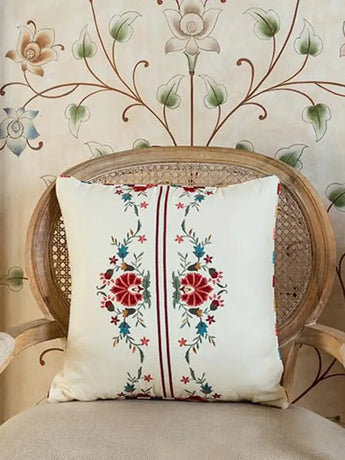
On a single accent chair, one cushion. Not two. A single cushion on a chair reads as styling. Two cushions on a chair reads as the chair has too many cushions.
Applying the Rule With MiRooh Cushions
The odd number rule works best when the pieces are not all identical. Three of the same cushion in a row is odd but still reads as a set. The rule pays off when the odd arrangement also has variation in size, fabric, or embroidery weight.
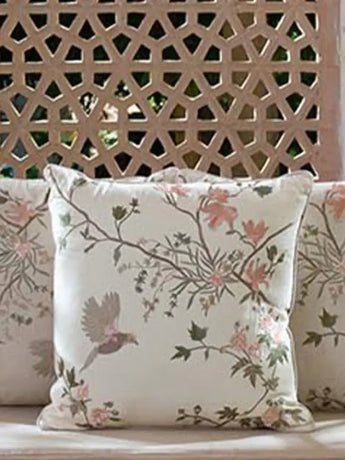
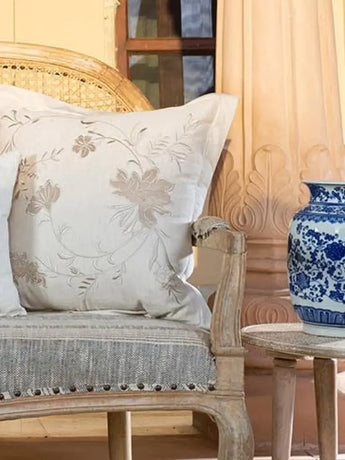
A working three-piece arrangement for a two-seater: one large Shazi Chikankari ivory cushion at the back, one medium Daneen Red velvet cushion in the middle, one Faiza Bolster at the front. Three distinct pieces, one from each visual weight category, and the odd total gives the arrangement its energy.
A five-piece arrangement for a three-seater: two Qadir Charcoal feather-touch velvet cushions at the back, two Khara Smoke pure Tussar silk cushions in the middle, and one Lehla Bolster at the front. Five pieces, three different textiles, one bolster to close the composition.
The One Exception
The rule has one exception that comes up regularly in Indian homes: the symmetrical sofa with identical arms and a formal structure. A carved wooden sofa with two identical arms sometimes looks best with a genuinely symmetrical arrangement: one matching pair on each arm and a single statement piece at the centre. This is still an odd total of five, but the placement is symmetrical rather than layered. Both approaches are valid. The rule is about total count, not necessarily about placement symmetry.
FAQ
Why do odd numbers of cushions look better?
Odd numbers prevent the eye from grouping objects into equal pairs, which creates visual movement and makes an arrangement feel dynamic rather than static. Even numbers resolve into symmetry immediately, which reads as formal and finished. Odd numbers keep the eye engaged.
Does the odd number rule apply to small sofas?
Yes. One cushion on a single chair, three on a two-seater, five on a three-seater. The rule scales down as well as up.
Can I use an even number of cushions if they are different sizes?
You can, but it takes more effort to make it work. If the sizes are genuinely different enough that the eye cannot pair them, the even total becomes less visible. The simplest path is always the odd number.
What counts as a cushion for the odd number rule?
Bolsters, lumbar cushions, and standard square cushions all count. A bolster at the front of an arrangement typically serves as the odd piece that resolves a four-cushion arrangement into a five-piece one.
Shop: Shazi Chikankari Collection | All Cushions | Bolster Collection