Indian Living Room Decor Ideas 2026: From Minimalist Flats to Heritage Havens
Your living room tells a story. In 2026, more Indian homes are choosing to make that story unmistakably their own, pulling from a thousand years of craft, colour, and cultural memory to create spaces that feel both personal and timeless.
Whether you live in a compact urban flat in Gurugram, a bungalow in Bengaluru, or a spacious family home in Lucknow, the living room is the first room guests see and the last room you leave at night. Getting it right matters.
This guide walks you through the most inspiring Indian living room decor styles trending in 2026, with practical advice on how to bring each one to life using cushions, curtains, and textiles as your primary tools.
01 The Minimalist Indian Flat

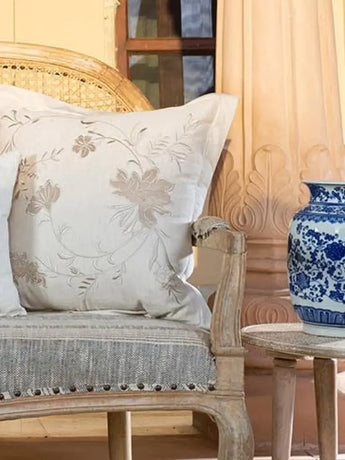
Clean lines and open floor plans dominate new-build apartments across Mumbai, Pune, and Delhi NCR. The instinct is often to go all-white or all-grey, but the smartest minimalist Indian interiors in 2026 use one or two pieces of deeply crafted textile to anchor the space without cluttering it.
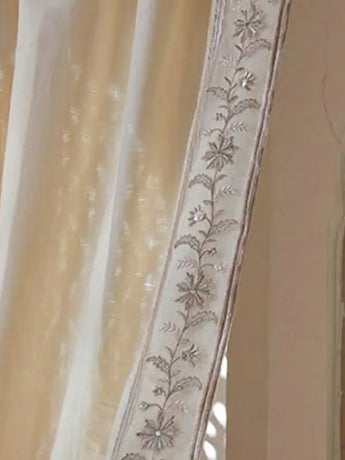
Think a pair of ivory Chikankari cushion covers on a light linen sofa, a single floor-length embroidered curtain panel at the window, and nothing else. The restraint makes the craft sing louder. Neutral backgrounds make handwork visible in a way that busier rooms cannot.
Key principle: buy fewer pieces and buy them with more intention. One handcrafted cushion with genuine embroidery is worth five generic printed ones.
MIROOH STYLING TIP
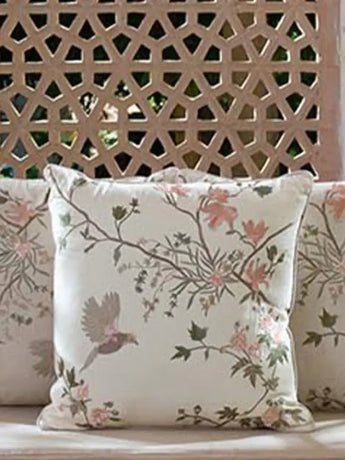
For a minimalist palette, explore the Shazi collection, which draws from Chikankari's fine white-on-white threadwork tradition, or the Baadamwari range with its soft botanical ivory tones from Kashmiri spring motifs.
Shop:- Shazi Collection (Chikankari)
Shop:- Baadamwari Collection (Kashmiri Spring)
02 The Rich Mughal Revival

Heavily influenced by Mughal manuscript painting, geometric jali patterns, and the deep jewel tones of Fatehpur Sikri and Agra, the Mughal revival aesthetic is having a major moment in Indian interior design circles in 2026. It works particularly well in formal living rooms, dining rooms, and home offices.
Deep teals, forest greens, burgundy reds, and antique golds form the palette. Velvet upholstery pairs with metallic thread embroidery. Curtains fall in heavy, floor-grazing panels. Bolster cushions appear on carved wooden daybeds. Every element has weight and intention.
The craft story behind this aesthetic is genuinely fascinating. Mughal court painters like Mushfiq, who contributed to Ramayana and Mahabharata manuscript illustration, created visual languages that are directly woven into Indian textile tradition. Bringing those motifs into a modern room is not decoration. It is living cultural memory.
Shop:- Mushfiq Collection (Mughal Art)
Shop:- Tarkashi Collection (Gold and Silver Wire Inlay)
Shop:- Browse Luxury Curtains
03 The Boho-Ethnic Living Room

The bohemian-ethnic aesthetic remains one of the most searched Indian living room decor styles online. It layers textures generously, mixes patterns fearlessly, and draws from multiple regional craft traditions simultaneously. Done well, it feels warm, collected, and personal.
The secret is to anchor the room with one dominant colour story, then layer within it. A sofa piled with cushions in forest green, deep ochre, and cream feels intentional if those tones repeat elsewhere in the room. Add a Phulkari-inspired cushion from Punjab, a tropical velvet piece from an Assam-influenced collection, and an embroidered throw across the armrest.
Curtains in this style work best when they are slightly off-white or warm neutral, so the patterned cushions remain the focal point. Sheer or lightly embroidered curtain panels work better than heavy block-printed ones in a boho interior.
Shop:- Sitta Collection (Phulkari, Punjab)
Shop:- Mahavan Collection (Tropical, Assam)
Shop:- Browse Throws
04 The Contemporary Heritage Room

This is perhaps the most sophisticated style on this list, and the one that MiRooh was built to serve. The contemporary heritage living room uses a modern architectural shell, clean furniture lines, and neutral walls as a stage for craft objects that carry genuine cultural weight.
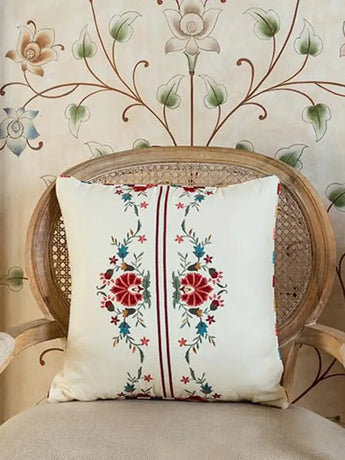
It is not about covering every surface with traditional objects. It is about placing two or three deeply meaningful, perfectly crafted pieces in a room designed to let them breathe. A pair of Bidriware-inspired Nakkashi cushions on a slate-grey sofa. A Tarkashi gold-and-silver wire-inlay bolster on a white linen bench. A single Chittakari hand-painted motif cushion on an accent chair.
Each piece becomes a conversation. Guests ask questions. The craft has a story. The room teaches while it decorates.
MIROOH STYLING TIP
In a contemporary heritage room, less is always more. Let three extraordinary pieces do the work that thirty ordinary ones cannot.
Shop:- Nakkashi Collection (Bidriware, Karnataka)
Shop:- Chittakari Collection (Hand-painted, Hyderabad)
Shop:- Browse Bolsters
How to Choose the Right Cushions for Your Indian Living Room

Regardless of which aesthetic style speaks to you, cushions are the most versatile and highest-impact tool in your living room decor kit. Here is a quick framework for choosing well.
Match fabric weight to room formality
Heavy velvet cushions belong in formal or heritage rooms. Linen and cotton weaves work in casual or minimalist spaces. Silk works in premium spaces where the room is not a daily family gathering spot. MiRooh uses internationally sourced feather-touch velvet and pure loom-woven silk, so the fabric quality is a genuine differentiator from mass-market options.
Use odd numbers and vary sizes
Three cushions on a two-seater sofa, five on a three-seater. Mix a 20x20 inch with an 18x18 and a long bolster. The eye reads odd groupings as deliberately styled, not randomly placed.
Let one cushion do the talking
In every grouping, let one cushion be the statement piece. The others support it. A finely embroidered Mushfiq cushion with Mughal manuscript motifs does not need company from another heavily patterned piece. Pair it with two solid or lightly textured companions.
FAQ
What is the most popular Indian living room decor style in 2026?
Contemporary heritage styling, which blends modern interiors with genuine handcrafted Indian craft objects, is the fastest growing aesthetic in urban Indian homes in 2026. It is followed closely by minimalist Indian interiors and the Mughal revival style.
How many cushions should I use on a sofa?
For a two-seater sofa, three cushions. For a three-seater, four to five. Always mix sizes and vary between one statement embroidered piece and two simpler companions to create a styled rather than crowded look.
What are the best curtain styles for Indian living rooms in 2026?
Floor-length panels in sheer or lightly embroidered fabrics work across all styles. For heritage and Mughal-revival rooms, heavy embroidered curtains with metallic thread work create the most dramatic effect. For minimalist rooms, one panel of fine linen with subtle detailing is sufficient.
How do I style cushions without making the sofa look cluttered?
Choose a tight colour story, no more than three tones. Use one statement piece and let the others play a supporting role. Vary size, not colour. And remove one cushion if it ever feels like too many. Restraint is a design skill.